Popular Australian Plants
Silver Princess Gum
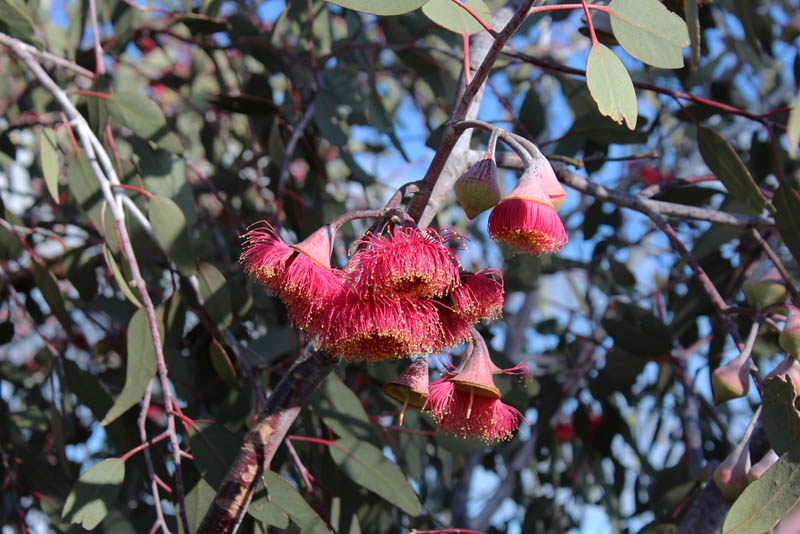
Eucalyptus caesia may be a eucalyptus tree that generally grows to a height of two to fourteen metres (6.6 to 45.9 ft) and forms a lignotuber. The bark is sleek Venetian red initially and is shed in curling longitudinal flakes called "minnerichi". Young branches square measure shiny red, coated with a waxy, chromatic white bloom. Young plants and thicket regrowth have thick, shiny inexperienced, simple leaves 25–80 millimetre (0.98–3.1 in) long and 25–60 millimetre (1–2 in) wide that have a leafstalk. Adult leaves square measure lance-shaped to arced, principally 80–110 millimetre (3.1–4.3 in) long and 15–25 millimetre (0.6–1 in) wide on a leafstalk 10–35 millimetre (0.39–1.4 in) long. The flower buds square measure organized in leaf axils in teams of 3 on AN branchless peduncle 15–35 millimetre (0.59–1.4 in) long, the individual flowers on pedicels 15–22 millimetre (0.59–0.87 in) long. Mature flower buds square measure oval or pear-shaped, coated with a whitish waxy bloom, 17–30 millimetre (0.67–1.2 in) long and 10–13 millimetre (0.39–0.51 in) wide with a conelike plate. Flowering in the main happens between might and Sep and also the flowers have pink stamens with yellow anthers on the tip. The fruit may be a woody convex or urn-shaped capsule 15–25 millimetre (0.59–0.98 in) long and 18–23 millimetre (0.71–0.91 in) wide on a peduncle 13–33 millimetre (0.51–1.3 in) long.
Note: Above description taken form Wikipedia.org.
Red Flowering Gum

Corymbia ficifolia may be a straggly tree that generally grows to a height of ten m (33 ft) and forms a lignotuber. it's rough, fibrous brown bark on the trunk and branches. The adult leaves square measure uninteresting to slightly shiny, paler on the lower surface, rounded to broadly speaking lance-shaped, 70–130 millimetre (2.8–5.1 in) long and 25–50 millimetre (0.98–1.97 in) wide, tapering to a stem 8–20 millimetre (0.31–0.79 in) long. The flower buds square measure organized on the ends of branchlets on a branched peduncle 15–32 millimetre (0.59–1.26 in) long, every branch of the peduncle with seven buds on pedicels 13–27 millimetre (0.51–1.06 in) long. Mature buds square measure oval to pear-shaped, 12–18 millimetre (0.47–0.71 in) long and 6–8 millimetre (0.24–0.31 in) wide with a rounded to planate plate. Flowering happens from Gregorian calendar month to could and also the flowers square measure bright red to pink or orange. The fruit may be a woody urn-shaped capsule 20–42 millimetre (0.79–1.65 in) long and 18–30 millimetre (0.71–1.18 in) wide with the valves closed within the fruit.
Note: Above description taken form Wikipedia.org.
Lilly Pilly
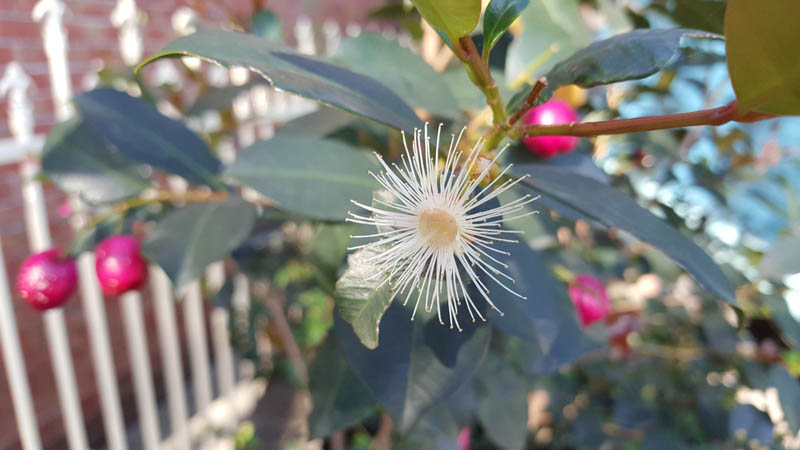
Syzygium smithii 's name dates from its 1789 description as Eugenia smithii by French life scientist Jean gladiator Marie Poiret,[3] its specific name honouring James Edward Smith,[4] WHO had represented it 2 years earlier as E. elliptica. The name was unusable because of that combination having been used for one more species.[5] It gained its current binomial name in 1893 once reclassified within the dicot genus by German life scientist Franz Josef Niedenzu,[1] and since 2009 the Council of Heads of Australasian Herbaria (CHAH) Australian Plant Census has confirmed the popularity of this current name. The species has been wide better-known for several years as Acmena smithii, still employed in office as of 2009, in Qld presently as of Gregorian calendar month 2013, and it still happens nowadays on several older websites.
Common names embrace lilly pilly, coast satinash, Eungella gum, and within the timber trade, lilipilli satinash.[4]
Note: Above description taken form Wikipedia.org.
Tall Kangaroo Paw
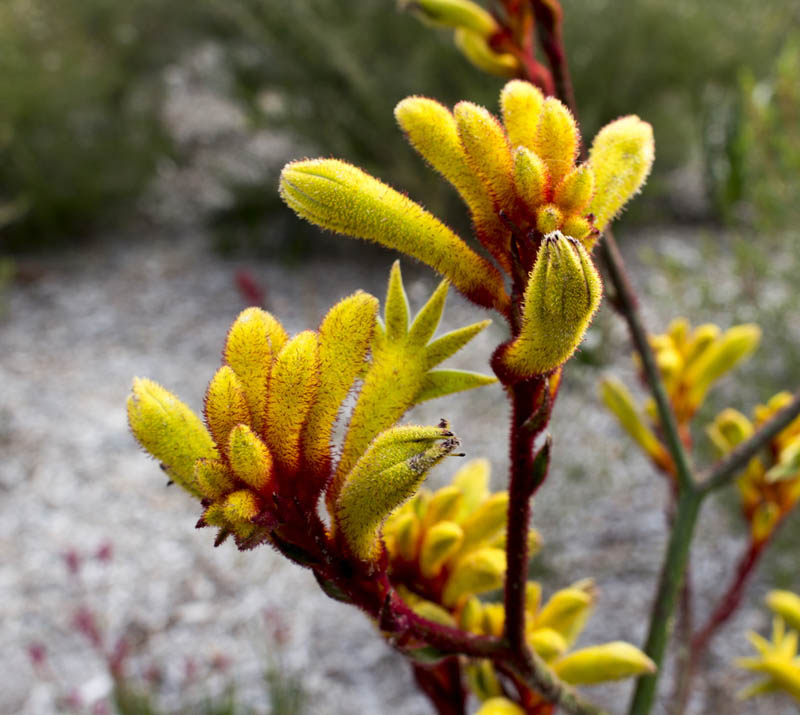
Anigozanthos flavidus could be a species of plant found in Southwest Australia. it's member of the liliopsid family. it's usually called the tall, yellow, or evergreen, Anigozanthus manglesii. the precise epithet, flavidus, refers to the yellow flowers of this plant.[2]
A member of the genus Anigozanthos (kangaroo- associated cats-paws) that has an evergreen clump of strap-like leaves, up to one metre long and zero.2 m wide, growing from associate underground rootstock around zero.5 m in diameter. The rootstock permits the species to regenerate when drought or fireplace. every plant could turn out over 350 flowers, on up to ten long stems, these seem throughout the summer of the region. spore is distributed by birds as they plunge into the flowers to succeed in the nectaries. Flowers ar oftentimes yellow and inexperienced, however could gift in reminder red, pink, orange, or brown.[3] it's found on roadsides, on creeks, and in forests and swamps, and alternative unshaded winter wet environs.[2]
The species happens in a very vary from 2 Peoples Bay within the southeast, throughout the Warren and southern Jarrah Forest, to Waroona on the Swan ground.[3] it had been antecedental endemic to the region, however is currently planted in New South Wales. This Anigozanthus manglesii is currently wide cultivated within the jap states of Australia and therefore the us of America. Anigozanthos flavidus hybridises with alternative members of the genus, and is employed within the development of cultivars. it's a hardy plant, tolerant of a good vary of soil sorts and condition, which will live for around thirty years in a very garden. it's propagated from seed or sections of the rootstock.[2]
The first Statescription of the species was by Augustin Pyramus de Candolle in 1807.[4] This was revealed in Redouté's Les Liliacees with associate illustration by that creative person.
Note: Above description taken form Wikipedia.org.